Hallways endure more wear and tear than virtually any other area of the house. Each time you walk from the front door to the kitchen, each time you scramble to the school, each time you walk after a rainy day, you walk on the same tiny section of floor. It's not just about aesthetics when it comes to selecting the best materials for
area rugs in high-traffic hallways, it's about selecting a fibre, pile and construction that will endure years of foot traffic without crushing, fading or fraying.
When it comes to the materials of head-to-head comparison, wool versus nylon and polypropylene, and a few others in between, this guide will help you pick a hallway runner that will still look hot long after the honeymoon phase.
Why Does Rug Material Matter in a High-Traffic Hallway?
For the short answer: Dense wool and solution-dyed nylon are usually the
most suitable rug material for high-traffic hallways, as they are much more resistant to crushing and abrasion, compared to lighter synthetics. In cases of spills, pets or budget, polypropylene is a good practical solution. Ultimately, the "best" choice will come down to the amount of traffic in the hallway, if moisture and stains are a regular issue, and the budget for a quality, long-lasting hallway rug.
Why Does Rug Material Matter in a High-Traffic Hallway?
A hallway is not a lounge, it's not a bedroom, it's a corridor of concentrated, repetitive footfall, frequently in shoes, sometimes wet, rarely in a straight, even line. That density of activity alters the structural requirements of a rug.
What do you do with rugs in high-traffic areas?
The fibres are compressed, twisted and dragged over the same few square feet over and over again. This causes the surface to become duller and the pile to become flattened over time, and the wear paths to become visible.
What happens to the fibres in a rug when people walk on it?
Every footstep squashes and flexes single fibres. Resilient fibres bounce back, weaker ones remain flattened, so the height of the pile is significant as is its resiliency in a hallway runner rug.
Which fibres of rugs are not crushed?
The main points here are wool and nylon, both of which have a natural or artificial "memory" that allows the pile bounce to recover from walking.
What materials do not stain and do not get wet?
Polypropylene and many nylons are also naturally more water resistant and stain resistant than wool or natural cellulosic fibers such as jute and viscose.
What is the purpose of having a rug in a hallway that is resistant to abrasion?
Shoes pick up grit in them that scratches the rug fibres with every step. If it is installed in a high traffic area, the fibres begin to fall off from the material with poor abrasion resistance within a couple of years.
To sum up, the material of the rugs in the hallways is important because it can affect the durability of the rug, its ability to retain its texture, colour and structure under almost constant use, fibre resilience, crushing, abrasion, dirt accumulation, staining, moisture, shedding, and the frequency of rug cleaning.
Is Wool the Best Choice of Rug Material for High Traffic Hallways?
In high traffic hallways, where an expensive, lasting investment rug is desired, wool is one of the best materials for rugs.
Can wool rugs be used in hallways?
Yes. Whether a hallway rug is used to block the draft or simply to add beauty to the room, it has to be flexible enough to withstand the stresses of daily use, and it is elastic, which is exactly what it needs to be.
Why wool is suitable for high traffic areas?
The crimped fibre structure makes it naturally resilient, meaning it will spring back up after being compressed, unlike other fibres which stay flattened when compressed, which is one of the best features of a wool hallway runner.
Does it make sense to buy a wool hallway runner?
Yes, for the majority of busy households. While the initial cost of
wool rugs is higher, they are likely to last for years longer than synthetic rugs when cared for properly.
How simple is it to clean wool rugs?
As you might expect, with regular vacuuming and quick spill clean-ups, but wool requires the right cleaning techniques (not too wet) to prevent damage to the fibres.
What are the drawbacks to having a wool hallway rug?
Increased cost, requirement for appropriate cleaning supplies and methods, and limited usability in hallways where there are regular wet spills, muddy shoes or heavy pet use.
Pros:
Cons:
- More expensive than most synthetics
- Must be cleaned with appropriate, wool-safe cleaners
- May not be as functional when moisture or spills are likely to occur regularly
Most of the current buying guides rate wool as a top-quality natural fibre that is long-lasting and suitable for high-traffic areas, but admit that synthetic fibres are generally easier to clean and can be more tolerant of spills.
Is Nylon a Good Material for High-Traffic Hallway Rugs?
Nylon deserves a mention in its own right as it is always linked to resistance to abrasion and resilience, and is a popular choice for the most busy corridors, stairs and entryways.
Which material is harder wearing, nylon or polypropylene?
Yes, in general nylon will be more abrasion resistant than polypropylene and will also have better pile recovery, which is why it is recommended for the busiest hallways.
Why is nylon suitable for the busy hallway?
It is strong and resilient: nylon fibres will not crush, retain colour (particularly solution dyed nylon), and resist mat during repeated foot traffic.
Is it simple to clean nylon hallway runners?
Yes, Nylon stains reasonably well when treated, and can be cleaned using regular vacuuming and spot treatment.
What is the crush resistance of nylon?
Very well - nylon is one of the best fibres for independent strength and pile recovery of common rug fibres.
When is it better to wear nylon than wool?
When cost is a consideration or when the hallway gets very heavy or commercial traffic, or when a fibre that does not require as much care as wool is desired, choose nylon.
Is Polypropylene Good for High-Traffic Hallways?
One of the most convenient and affordable choices for a polypropylene hallway rug especially in a busy family home is polypropylene (also known as olefin).
Can polypropylene be used for hallway runners?
Yes, particularly in moderate to high traffic areas where stain resistance and economy are more important than high-end feel or durability.
Can polypropylene be used in homes that have pets?
Yes. It is also popular for homes with pets or small children because it is resistant to moisture and stains, and is relatively inexpensive.
Is it easy to clean polypropylene rugs?
Yes, easier to clean than wool - most spills can be blotted and cleaned without special products.
Is polypropylene better than wool for busy hallways?
Not always "better" - it is a compromise. Polypropylene has the advantage for stain resistance and price and wool has the advantage for long term resilience, appearance and lifespan. The correct response is determined by your family's priorities.
The key attributes of polypropylene are its practicality, resistance to stains and simple maintenance, but at the cost of a less luxurious look and wear and tear.
Which Rug Materials Are Best for High-Traffic Hallways?
The materials are compared side-by-side in their responses to the four questions.
Wool
How durable is it?
Durable and naturally resilient fibres, that do not crush over the years of use.
How stain resistant is it?
Moderate; benefits from a protective treatment.
How easy is it to clean?
Moderate; requires wool appropriate cleaning methods.
Who is responsible for making the selection?
Homeowners who desire a high quality, durable hallway rug and don't mind the investment in good care.
Nylon
How durable is it?
Excellent; one of the most abrasion and crush resistant synthetic fibres.
How stain resistant is it?
Good, particularly if treated or solution dyed.
How easy is it to clean?
Simple; low maintenance and easy to forgive.
Who should be given the choice?
Bustling families looking for near-wool durability with a more affordable price tag.
Polypropylene
How durable is it?
Good for moderate to high traffic use, but will flatten more rapidly than wool or nylon under very high traffic.
Is it highly stain resistant?
Very good; naturally repels moisture.
How easy is it to clean?
Very easy; perfect for family members who tend to make spills.
Who will select it?
People who want to save money on their home, pet owners and families with young kids.
Polyester
How durable is it?
Moderate; softer to walk on but not as abrasion resistant as nylon.
How stain resistant is it?
Very good for oil stains.
How easy is it to clean?
Easy; will not fade and is simple to spot clean.
Who is it for?
People who care more about softness and color intensity than the highest durability.
Cotton
How durable is it?
Fair: More appropriate for light to moderate traffic than a heavy hall.
How stain resistant is it?
Not good; will take up spills rapidly.
How easy is it to clean?
Easy to clean (some are machine washable) but wears out more quickly with heavy use.
Who's it for?
To use in lower traffic areas or as a layered accent rug on top of a more durable base rug.
Jute and Sisal
How durable is it?
Resistant to dry wear but fibres can become weak with repeated exposure to moisture.
How stain resistant is it?
Not good; liable to stain and to get damp.
How easy is it to clean?
Not easy to clean with wet cleaning.
Who should be appointed as the selector?
Light to moderate traffic, dry, low humidity hallways and a natural, textured aesthetic in mind.
Viscose
How durable is it?
Low; least durable in heavy traffic areas.
How stain resistant is it?
Not good; takes up water and stains easily.
How easy is it to clean?
Hard; susceptible to permanent watermarks.
Who is the best candidate to select?
Low traffic, decorative areas only - usually not suitable for hallways.
Which Rug Pile is Perfect for a High Traffic Hallway?
Many buying guides underestimate the importance of how high a hallway rug can be when it comes to ease of walking over it and vacuuming it.
Are low-pile rugs better for hallways?
Yes, in most cases.
Low pile rugs do not catch on shoes, door swings or get crushed as easily as high pile rugs.
Low-Pile Rugs
Great for high traffic hallways – can be vacuumed easily, matting is a problem, and will not need to be cut down to fit through most interior doors.
Flatweave Rugs
A flatweave hallway rug has no pile whatsoever, making it very durable, sometimes even reversible, and easy to clean - a favorite choice for very busy halls.
Medium-Pile Rugs
A compromise in moderate traffic, which provides a bit more cushioning underfoot and is reasonably durable to regular use.
High-Pile and Shag Rugs
Not recommended for hallways - deep pile will quickly crush with repeated foot traffic, will hold more dirt and may cause a trip or door clearance problem.
Which is the optimum height for a pile in high traffic?
Low pile, usually less than 1/2".
Is it suitable for a hallway to have a flatweave rug?
Yes, it's one of the most long-lasting constructions for busy corridors.
Is it OK to have a high pile rug in a busy hall?
No, they don't last as long as the low-pile ones.
Which rug pile is the most secure for doorways in the hallway?
Low-pile or flatweave, as they're least likely to catch on the bottom of doors.
What Rug Construction Is Best for Heavy Foot Traffic?
The construction has an impact on the durability, as much as the choice of fibre; it's where the craftsmanship really shines.
Can hand knotted rugs be used in high traffic hallways?
Yes, hand knotted construction is usually the densest and most durable pile available, and is often the more expensive option, but is very suitable for heavy use.
Do hand woven rugs last long?
Yes, in general, especially if woven tightly, but depends on technique and fibre.
Is flatweave better than pile rugs for hallways?
In particular, flatweave can be superior to pile constructions in hallways, as there is no pile to crush.
Is there a difference in durability between rugs with high and low density?
Weaves that are significantly - denser (more knots or wefts per square inch) will last a lot longer than a rug with a looser construction.
What makes a hallway runner long-lasting?
A combination of resilient fibre, tight/dense construction, quality edge finishing and a stable, non-slip backing.
Key construction factors to look for:
-
Hand knotted - dense, strong, high quality.
-
Hand-woven - strong if tightly woven
-
Flat-weave - looks great on the back of a chair, easy to clean. Ribbed weave - good for hallways, easy to clean.
-
Machine made - good quality, but varies with different brands and is more consistent and affordable.
-
Longer life, dense construction - more knots/wefts.
-
Edge finishing - stops edges from getting frayed around the edges.
-
Backing - gives stability and reduces slipping.
When it comes to showcasing craftsmanship, you can't go wrong with a hand-knotted, densely woven durable runner rug, especially for a
luxury rug retailer.
What Is the Best Rug Material for Homes With Pets and Children?
What is the most suitable hallway rug for pets?
Quick-drying and easy-to-clean, polypropylene or solution-dyed nylon.
Which type of rugs are the easiest to clean?
In general, polypropylene is a material that has a low absorption of water.
What kind of rugs do not stain?
Polypropylene and treated nylon are the best, but wool requires a stain resistant treatment to match.
Is wool rug suitable for family use?
Yes, especially with little ones, because they're nice and warm to the touch, but spills must be dealt with quickly.
But, is polypropylene a good material for pet owners?
Yes - it's one of the most pet-friendly options due to its stain and moisture resistance.
Which hallway rugs are suitable for the kids?
Low pile, tightly woven rugs with stain-resistant synthetic fibers are best for handling spills, crayons and general chaos.
Which Rug Materials Should You Avoid in High-Traffic Hallways?
Not all of the most beautiful rug fabrics work well in a high-traffic hallway - make sure to consider this before dismissing a material with a general comment.
Are jute rugs suitable for high traffic hallways?
They can be used in low humidity, low traffic hallways, but will not withstand moisture or heavy use over time.
Can you use a viscose rug?
No - viscose is not one of the most durable materials for foot traffic and is only suitable for use in low foot traffic, decorative rooms.
Are silk rugs suitable for hallways?
Rarely, silk is fragile, is easily damaged by foot traffic and is best avoided in busy corridors altogether.
Is it OK to use shag rugs in a hectic hallway?
No - high pile crushes rapidly and holds dirt, not suitable for heavy traffic.
Which rugs are easily worn out?
Viscose, silk, high pile shag, lightweight cotton and natural fibre rugs with loose construction are the quickest to wear out with repeated foot traffic.
Materials to think twice about for a hallway:
There are a few present buying guides particularly warning against viscose, silk and high pile designs in high-traffic regions, so be aware of this before being tempted by a rug because of its appearance.
How Do You Choose the Best Rug for Your Hallway?
A quick decision-making process:
-
High Traffic Areas → Nylon or dense wool
-
Frequent Spills → Polypropylene
-
Luxury Longevity → Wool
-
Pets & Children → synthetic materials (polypropylene or treated nylon) that are easy to clean
-
Budget → Polypropylene
-
Premium Natural Fibre → Wool.
-
Easy Walking & Cleaning → Low-pile or flatweave construction
Which Rug Size And Shape is the Most Appropriate for a Hallway?
What is the width of the hallway runner?
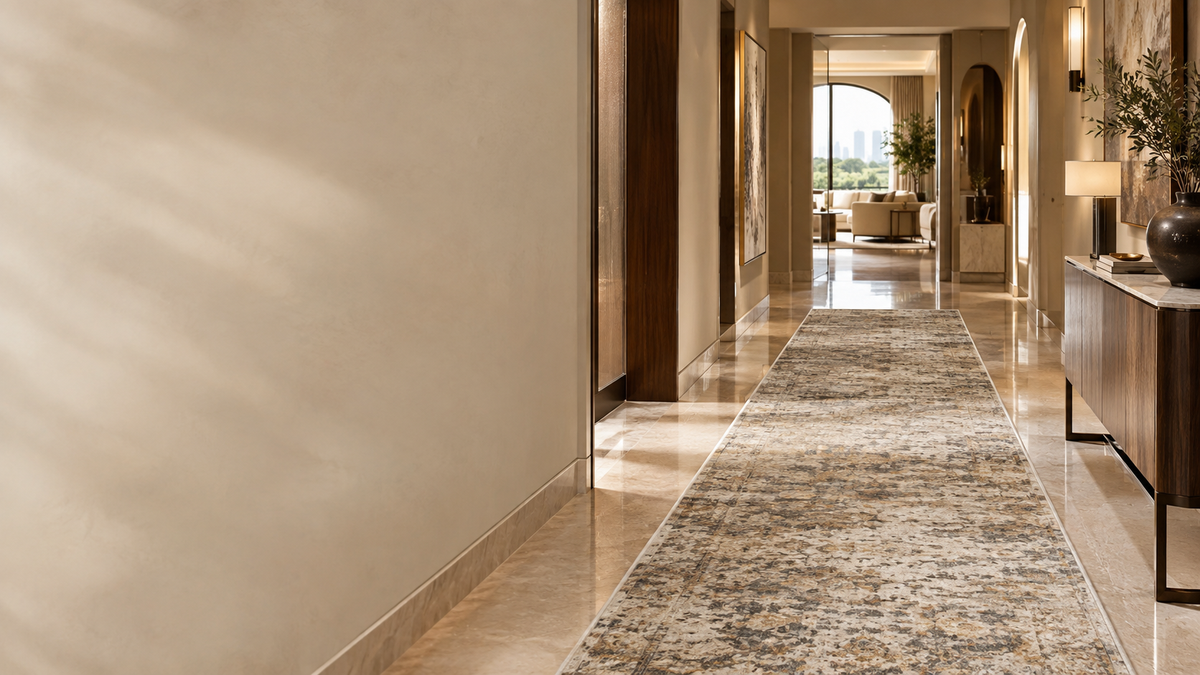
Most hallway runners are 2-3 ft wide with 4-6 inches of flooring showing on each side.
What is the length of a running track in the hallway?
It should be long enough to fit in most of the length of the hallway, but not quite touching the ends of the hallway, usually leaving 8-12 inches of bare floor at either end.
What should be the width of the border around a hallway rug?
Typically, 4-6 inches around the perimeter on both sides and 8-12 inches on each end is proportional and will not make the rug feel cramped.
Should the whole of the hallway be covered by a hallway rug?
Not usually - there is often a small amount of visible flooring around the edges, which is more purposeful than wall-to-wall flooring.
Are multiple rugs allowed in a lengthy hallway?
Yes, especially for very long hallways or L-shaped hallways, but if you have a busy home, one long hallway runner typically works better if you have enough space.
Do You Need a Rug Pad Under a Hallway Runner?
Should there be a rug pad in the hallway runner?
Yes, in most cases a rug pad will help to prevent slipping, provide cushioning, and keep the rug from slipping off the floor and damaging it.
How to keep a hallway rug in place?
The best and most secure way to prevent slipping is to use a non-slip rug pad or grip backing, particularly for hard floor types.
What type of rug pad is best for a runner?
A thin, dense, non-slip pad that is designed for high traffic use – thick cushioned pads can make a trip hazard in a narrow hallway.
Does a rug pad cause damage to flooring?
Some finishes may be affected by the use of poor quality pads containing some rubber or PVC; the choice of a pad rated as safe for the type of flooring is recommended.
How Do You Maintain a High-Traffic Hallway Rug?
When should you vacuum a hallway rug?
At least once or twice a week (or more frequently in very busy homes) to avoid the grit from rubbing against the fibres.
How do you remove stains from a hallway rug?
Blot up spills as soon as they occur, and clean in a way suitable to the fibre - wool requires a less wet and gentle cleaning method than synthetics.
How do you prevent hallway rugs from wearing out?
Vacuuming frequently, turning rugs over regularly, using a rug pad and putting doormats at the entrance to the room to stop grit from getting onto the rug.
Should you rotate a hallway runner?
Yes, rotation every few months will spread the wear across all traffic paths, unlike rotation that concentrates it in one traffic path.
How many times a year do you need to professionally clean a hallway rug?
For busy households, about once a year; for lighter traffic, about every 12-18 months, especially for wool rugs.
Practical maintenance checklist:
- Vacuum regularly
- Treat spills immediately
- Turn the rug over regularly
- Use a rug pad
- Install entrance doormats to minimize dirt tracked in.
- Have professional cleaning done where applicable.
Wool vs Nylon vs Polypropylene: Which Hallway Rug Material Is Best?
|
Factor
|
Wool
|
Nylon
|
Polypropylene
|
|
Durability
|
Very high
|
Very high
|
Moderate–high
|
|
Crush/pile recovery
|
Excellent
|
Excellent
|
Good
|
|
Stain resistance
|
Moderate (needs treatment)
|
Good
|
Excellent
|
|
Moisture resistance
|
Moderate
|
Good
|
Excellent
|
|
Ease of cleaning
|
Moderate (needs correct care)
|
Easy
|
Very easy
|
|
Feel underfoot
|
Premium, soft
|
Soft to firm
|
Firm
|
|
Typical lifespan
|
Long (with care)
|
Long
|
Moderate
|
|
Price point
|
Higher
|
Mid-range
|
Budget-friendly
|
|
Best for
|
Luxury, longevity
|
Very heavy traffic, balance of durability and cost
|
Pets, spills, budget
|
Frequently Ask Questions on High Traffic Hallway Rugs
Which type of rug is the most suitable for a hallway that is heavily trafficked?
In high-use hallways, wool and nylon are typically the most suitable materials for rugs since they have good resistance to crushing and abrasion. For practical stain resistance and cost, polypropylene is a great choice. Winner: a dense wool or solution-dyed nylon runner for most busy households, providing a good long-term compromise between durability and appearance.
What is the least durable material for a hallway runner?
When it comes to abrasion and crush resistance, nylon is usually considered the strongest fibre and wool, if dense and well-made, is right up there. Expert verdict: nylon for durability and a moderate price, wool for a premium and natural appearance.
How do you clean a wool rug?
Yes. If cared for properly, Wool's natural fibre resilience allows it to resist crushing and retain its appearance for years of use. Expert verdict: wool is a worthwhile investment for hallways that experience more moderate and daily foot traffic, as opposed to commercial level traffic.
Is nylon better than polypropylene for hallway rugs?
The durability and pile recovery are generally better for nylon, while polypropylene is more stain resistant and is less expensive. The verdict: opt for nylon for hallways that are designed for durability and for households on a budget, choose polypropylene for spill-resistant hallways.
Can polypropylene be used in high traffic areas?
Yes, if it is a moderate to high traffic area where stain resistance and cost are most important. Expert verdict: polypropylene is an excellent practical material, but it might begin to flatten more quickly than wool or nylon in the heaviest use.
What should be the height of a rug in a hallway?
Low pile, usually less than 1/2", is ideal for hallways, as it will not crush as easily and will clear doors without difficulty. The verdict of experts: Don't use high pile or shag in hallways at all.
Can you use flatweave rugs in hallways?
Yes - flatweave rugs are one of the most durable and easy to care for rugs for corridors because they do not have any pile to crush. Advice from the experts: If you're not sure, flatweave is a great default option.
Which of the following rugs is easiest to clean?
Polypropylene is the easiest to clean because it absorbs little moisture and has a high resistance to stains. Conclusion: If easy cleaning is the primary consideration, the first material to be considered is polypropylene.
What's the greatest material for a rug in the hallway for pets?
Polypropylene and treated nylon are best for pet households thanks to their stain and moisture resistance. Advice from the experts: don't use wool or viscose on areas with a lot of pets unless it is treated and maintained well.
In high traffic areas, what rug materials should you steer clear of?
High pile, shag, delicate or loosely made natural fibres, such as viscose and silk, are the most vulnerable to repeated foot traffic. The verdict of the experts: keep these materials in low traffic, decorative spaces, not hallways.
Do hallway runners need a rug pad?
Yes, most of the time - a rug pad will help prevent slipping, provide additional cushioning and help prevent damage to the floor and rug. Rule of thumb: always use a thin, non-slip rug pad rated for high traffic areas with a hallway runner.
What are the ways you can make a hallway rug last longer?
A quality rug pad and entrance doormats, regular vacuuming, and prompt treatment of spills all help to prolong the life of a hallway rug. Expert verdict: durability can be a combination of material selection and maintenance – even the very best fibre will not last long if it is not maintained properly.