
Handmade Rug Buying Guide 2026: All You Need to Know Before Buying a Rug
Handmade rug is a rug that is woven, knotted or looped by hand, not by a machine. One investment equals more craftsmanship, longer life and actual resale value. Whether you are looking for luxury rugs in UAE or anywhere else in the world, this handmade rug buying guide is for you who want a rug that will last for decades, not seasons.
From materials and sizes to shapes, colours, styles, quality control and the pitfalls to avoid, this guide covers everything so that your next rug will be a decision you never have to make again.
1. Why Handmade Rugs Are Worth the Investment
There are several reasons why handmade rugs are worth the investment.
A handmade rug is not simply a floor covering, it's a piece of investment and there are six reasons for this:
Craftsmanship:
All handmade rugs, whether hand-knotted, hand-tufted or flatwoven, are made by a master weaver and not a machine loom. That artisan work is revealed in the accuracy of the pattern, the uniformity of the pile and in the details that machines cannot duplicate.
Longevity:
With proper care, a handmade rug can last 20-100+ years. Machine-made rugs have a lifespan of 3 to 8 years before they lose their height or backing.
Resale value:
Hand-knotted rugs, particularly wool or silk, can appreciate or appreciate over time, similar to fine furniture or art. Machine-made rugs have virtually no resale market.
Sustainability:
Most handmade rugs are made using natural materials (wool, cotton, jute, silk) and traditional, low-energy processes, whereas most machine-made rugs are made with synthetic fibres and high-energy processes.
Natural Materials:
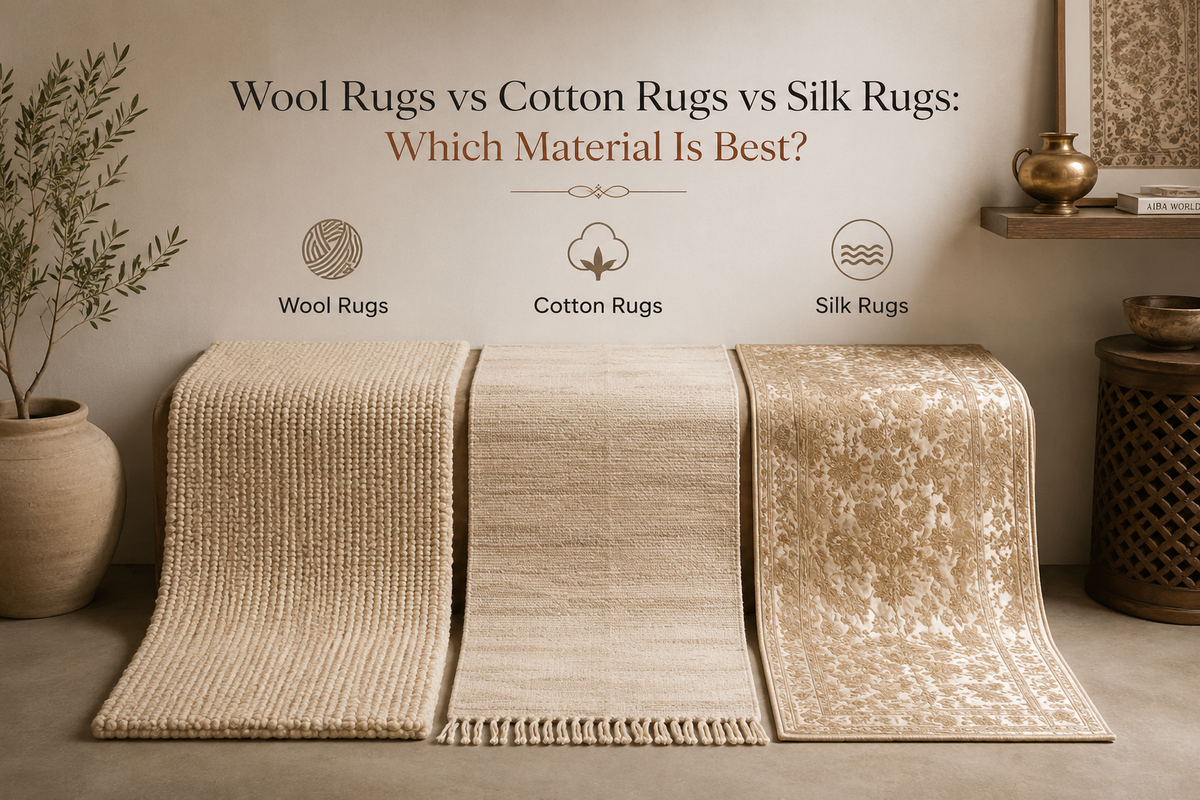
Wool, cotton, silk, jute and bamboo silk breathe, resist static and age gracefully, without showing signs of wear.
Artisan Work Supports Real Livelihoods:
A handmade rug is a way of supporting the skilled weavers and the communities they belong to, which a factory-made rug can't do.
If you're weighing designer rugs or premium rugs against cheaper alternatives, the investment case for handmade almost always wins over a 10+ year horizon.
2. Handmade Rug vs Machine-Made Rug
Here's a side-by-side comparison to help you decide between a handmade rug and a machine-made rug:
|
Factor |
Handmade Rug |
Machine-Made Rug |
|
Manufacturing |
Woven/knotted by hand, often over weeks or months |
Produced by power looms in minutes to hours |
|
Durability |
Extremely high - can last generations |
Moderate - typically 3–8 years |
|
Feel |
Dense, textured, natural fibre softness |
Often flatter, more uniform, synthetic feel |
|
Value |
Retains or appreciates in value |
Depreciates like any mass-produced item |
|
Price |
Higher upfront cost |
Lower upfront cost |
|
Lifespan |
20–100+ years with care |
3–8 years average |
|
Repairability |
Can be re-knotted, patched, and restored |
Usually not repairable - replace when worn |
In short, handmade is the winner if you're looking for a rug that you'll be using - or passing down - in 20 years. Machine-made can be a viable option for a low-traffic area or for a short-term rental where cost is a concern.
3. Types of Handmade Rugs
Handmade rugs are not created in the same fashion. There are four major types:
Hand-Knotted Rugs:
Traditional hand-knotted rugs are made by tying thousands, if not millions, of knots onto vertical warp threads. Each knot is hand-knotted, resulting in a rug with a unique design and character. Production takes several months to more than a year depending on the knot density (KPSI or knots per square inch). They are typically made from high-quality materials like wool, silk, or cotton, providing exceptional durability and intricate detailing. Hand-knotted rugs are one of the most valuable and collectible rugs, as there is no adhesive involved, they can last for generations with proper care.
- Ideal For: Living rooms, formal rooms, heirloom items
- Pros: Exceptional durability, intricate detail, highest resale value
- Cons: Most expensive, longest production time
Hand-Tufted Rugs
Hand tufted rugs are the rugs that are created by tufting rather than tying knots with a hand tufting gun in a stretched fabric backing. After the desired pattern is finished, latex adhesive is placed over the yarn, and then a secondary backing for additional stability. The technique enables artisans to produce intricate patterns in a faster time than hand knotting but with a soft and plush pile. Hand-tufted rugs come in a range of materials, including wool, viscose, cotton, and blends, and are a great choice for modern rugs in the home for their craftsmanship, comfort, affordability, and design.
- Ideal For: Bedrooms, medium traffic spaces, budget statement items.
- Pros: Hand-knotted, glued backing may lose durability over time.
- Cons: Lower quality than hand-knotted, limitations in design range, faster production, more expensive than hand-knotted.
Flatweave Rugs
Flatweave rugs are made by weaving horizontal weft threads together with vertical warp threads, but not by knotting or piling the rug. Rugs made using traditional weaving techniques like plain weave, tapestry weave or kilim weaving are lightweight and durable, with reversible patterns. Flatweave rugs are easy to clean, breathable, and perfect for high-traffic spaces, dining rooms, kitchens, and hallways, as they do not have a thick pile. They are typically made of wool, cotton, jute or synthetic materials, and feature geometric, tribal or modern patterns and designs, yet offer exceptional functionality and versatility in daily life.
- Ideal For: High traffic areas, layering, outdoor adjacent spaces, warm climates
- Pros: Less plush underfoot, thinner profile
- Cons: Limited durability, prone to fading, not as durable as leather, requires replacement every few years, can be difficult to replace.
Hand-Loomed Rugs
Hand-loomed rugs are made on a loom that is the same as the one used in the past, but with the difference that the warp and weft threads are controlled by hand to produce uniform textures and modern designs. Unlike hand-knotted rugs, these rugs are woven without knots, which means they can be woven faster than hand-knotted rugs, but are still handcrafted. Artisans can use looped, cut-pile or textured weaving techniques to create a variety of surface finishes, depending on the design. Hand-loomed rugs are often made from wool, cotton, viscose or even mixed fibres, and are highly durable, well-constructed and clean and simple enough to fit into modern interior decoration.
- Ideal For: Contemporary spaces, mid-range budgets, modern rugs.
- Pros: Less expensive than fully hand-knotted pieces, more prestige/resale value than machine knitted pieces.
- Cons: No support for 64-bit, no option to disable the default language, no support for the new default language
4. Best Rug Materials Explained
New Zealand Wool
-
Durability: Moderate - delicate, best in low-traffic zones
-
Softness: High, but has a little bounce to it.
-
Maintenance: Low - resists dirt, easy to vacuum
-
Best Room: Kitchens, bathrooms, basements, garages, etc.
Bamboo Silk (Viscose alternative)
-
Durability: Moderate – fragile, suitable for low traffic areas
-
Softness: Very high - silky, luminous sheen
-
Maintenance: Gently clean with professional methods
-
Best Room: Formal living rooms, bedrooms, statement/accent pieces
Cotton
-
Durability: Moderate
-
Softness: Soft and breathable and flat.
-
Maintenance: Many cotton flatweaves can be washed
-
Best Room: Kids' rooms, kitchens, casual areas
Jute
-
Durability: Good in low moisture areas, will wear in damp conditions
-
Softness: Natural texture, coarser
-
Maintenance: Low (do not wet clean)
-
Best Room: Study rooms, layered looks, boho-style interiors
Viscose
-
Durability: Low to moderate - easily crushed; watermarks: Low to moderate - easily watermarked
-
Color: Blackish-brown with a reddish tinge at the base of the feathers.
-
Size: Small, 12 cm.
-
Care: High maintenance, avoid heavy traffic and moisture.
-
Best Room: Bedrooms, formal sitting areas, low traffic showcase spaces
5. How to Choose the Right Rug Size
The biggest error customers make is in selecting the wrong size rug. These are visual guidelines to start with:
-
Living Room: Rug should be sufficient to accommodate all the front legs of your sofa and chairs (usually 200x300 cm or bigger for a typical seating arrangement).
-
Bedroom: Use a rug that is at least 45-60 cm longer than the bed on each side or two smaller rugs on each side.
-
Dining Room: Extend 60-70 cm beyond the table's edge on each side to ensure that chairs remain on the rug when pulled out.
-
Hallway: Runner rugs should show about 10-15 cm of the floor on each side.
-
Entryway: The rug should be large enough to cover the area in front of the door, which is usually 90x150 cm or larger.
Tip: Measure your room before purchasing the rug, and use painter's tape to outline the rug's size to avoid the most frequent (and costly) sizing error.
6. Choosing the Right Rug Shape
- Rectangle: This is the most versatile and popular shape that is used in almost every room and furniture arrangement.
- Round: Best for creating a more rounded look for furniture arrangements, round dining tables, or entryways.
- Oval: An oval rug is an alternative to rectangular rugs that are softer and more suitable for elongated rooms or oval dining tables.
- Runner: Designed for hallways, kitchens and staircases.
- Irregular Shape: Ideal for spaces that are used to make a statement, rather than as a floor covering.
7. Choosing the Right Rug Colour
- Neutral rugs: Beige, ivory, and taupe rugs help to create a peaceful ambiance and allow furniture to take center stage.
- Modern interiors: Large monochrome, greys or abstract colour-blocked rugs can work well in modern, clean and contemporary spaces.
- Luxury villas: Luxurious jewel tones – deep blue, emerald, burgundy – with silk or wool for opulence.
- Arabic interiors: Warm golds, deep reds and multi-tone patterns lend Arabic interiors a rich texture to traditional Majlis and heritage-inspired décor.
-
Minimalist homes: Soft greys, off-whites and single-tone rugs create a pared-back, uncluttered look.
8. Rug Styles Explained
- Modern: Clean lines, little or no patterns, sometimes solid, sometimes slightly textured.
- Contemporary: Modern design elements – a blend of textures, asymmetry, new colour palettes.
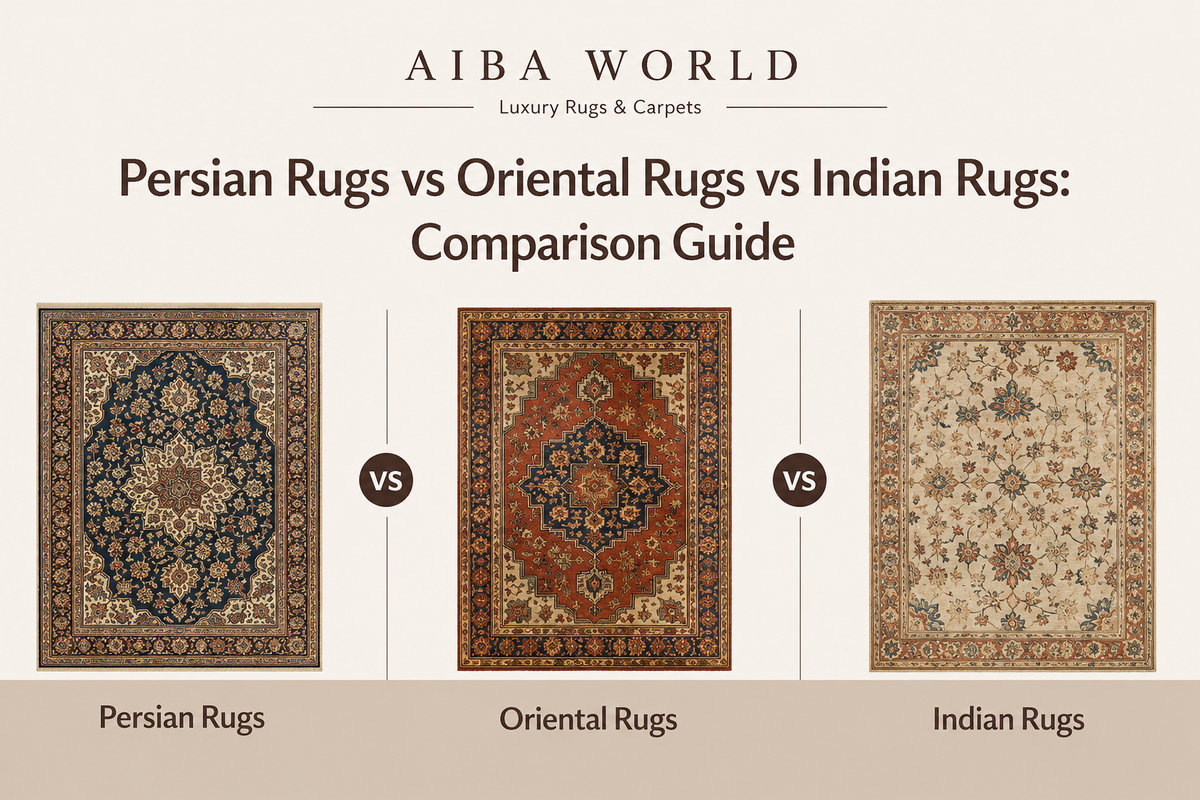
- Persian Inspired: Complex medallions, flowers and borders inspired by centuries of weaving.
- Geometric: Shapes and strong lines that are repeated - a popular choice for contemporary and Scandinavian design.
- Abstract: Patterns of art, painterly, without any particular motif – a statement piece for contemporary rooms.
- Heritage: Traditional designs reworked in a contemporary colour scheme or size.
- Scandinavian: Cool colors, plain geometric or organic shapes, natural fabrics.
- Minimalist: Solid colours or subtle texture, meant to be subtle and not overpowering.
9. What to Avoid When Shopping for a Rug
Before you buy, inspect these six things:
- Knot Density: The more knots per square inch (KPSI), the finer the detail and the more durable. Request the KPSI count from the seller.
- Material: Check for fibre content (wool, silk, bamboo silk, cotton) - real natural fibres will have a different feel to a synthetic blend and should be clearly identified.
- Back of Rug: One of the most telling signs of a genuine hand-knotted rug is the pattern that can be seen (in reverse) on the back.
- Edge Finishing: Check for tight edges and fringes woven, not glued or stapled.
- Dye Quality: The colours should be uniform, not just on the top of the pile, but throughout the pile - bend the pile over to see if the base colour matches.
- Weaving Consistency: Look for even pile height and pattern alignment - if it's uneven or not aligned, it may indicate rushed or poor quality production.
10. Best Rugs for Every Room
- Living Room: Hand-knotted wool rugs that are medium to large in size and suitable for daily use.
- Bedroom: Use soft bamboo silk or wool-blend rugs for a cozy, barefoot-friendly area.
- Dining Room: Low pile flatweaves or wool rugs that are not easily crumpled or moved by chairs.
- Office: Low pile, easy to clean rugs made of wool or wool blend, which can be rolled up.
- Hotel: High density, hand-knotted wool rugs designed for heavy commercial traffic.
- Villa: Statement luxury carpets UAE style – silk or wool hand knotted carpet for large open plan areas.
- Majlis: Traditional or heritage rugs in warm, rich hues for formal seating spaces: Majlis.
11. Rug Care & Maintenance
Cleaning: Blot up spills as soon as they happen; use mild chemicals on natural fibres.
Vacuuming: Vacuum on a low suction or no-beater-bar setting once a week to prevent damage to the pile and fringes.
Rotate: Turn the rug 180° every 6-12 months to wear and sun evenly.
Sunlight: If possible, avoid leaving rugs in direct, prolonged sunlight, as this can cause colour to fade; use curtains or UV film to protect rugs from direct sunlight.
Professional Washing: Professional clean rugs with hand-knotted and silk/viscose every 12-18 months or more often for high traffic areas.
Storage: Store rugs by rolling (not folding), wrap in permeable material and keep in a dry, pest-free place.
12. Buyer Errors
Buying Too Small: When in doubt, size up a rug, as it can make a room feel disjointed if it's too small.
Ignoring Material: Selecting the fibre based on appearance only and not considering whether the fibre is appropriate for the traffic and climate of the room.
Selecting Style Over Function: Letting a design get to your head before considering how it will be used in the space (such as a fine viscose rug in a high traffic hallway).
Ignoring Maintenance: Purchasing a material that requires a lot of maintenance but you are not prepared to do so.
Ignoring Pile Height: Too high can block doors or furniture, and too low can not provide the comfort you desire underfoot.
Why Choose Aiba World
Here's what makes Aiba World unique when it comes time to purchase:
Handmade in India: Each rug is handmade with traditional methods and techniques that have been passed down for generations by skilled weavers.
50+ Artisans: A dedicated network of over 50 artisans hand-knot, hand-tuft, and hand-weave every piece - real craftsmanship, not mass production.
Sustainable Materials: Sustainable natural wool, cotton, silk and jute, reducing environmental impact.
Home Trial: Not sure how a rug will look in your space? Test it out in your own home, without risk before you commit.
Custom Rugs: Looking for a particular size, colour or pattern? Aiba World provides you with fully custom rugs.
Worldwide Shipping: No matter where you are, you can order a handmade rug from anywhere.
Ready to choose your handmade rug?
Explore Aiba World's handmade rug collection or try selected rugs at home before you buy.
Shop Handmade Rugs
Try at Home in UAE
Frequently Asked Questions
How long do handmade rugs last?
Handmade rugs, especially hand knotted wool rugs, will last 20 to 100+ years, much longer than machine-made rugs.
But are wool rugs better than synthetic rugs?
Generally, yes. Wool is far more durable, naturally stain resistant, hides dirt well and is much more sustainable than synthetic fibres such as polyester.
What is the difference between hand-knotted and hand-tufted rugs?
Hand-knotted rugs are knotted by hand, one by one, onto a foundation, and are more durable and valuable. Hand tufted rugs are made with a glued backing and are quicker to make and cheaper than handmade rugs, but less durable over time.
What is the most suitable rug for the living room?
A medium to large size hand-knotted wool rug works best - it's soft, durable and can withstand daily use.
How to tell if a rug is handmade?
Look at the back of the rug: If it is a handmade rug, the pattern should show up in reverse on the back. Machine made rugs are usually backed with a uniform, patterned backing that is glued to the rug separately.
Do bamboo silk rugs last?
Bamboo silk rugs are beautiful, luxuriously soft and less durable than wool. They're best suited to low-traffic areas like formal living rooms or bedrooms.
What size rug do I need?
It will depend on the room and furniture arrangement - generally, size up, not down. For exact recommendations, please see our full room-by-room size guide above.
Are handmade rugs washable?
Most handmade rugs should not be washed in the washing machine. Clean up any spills as soon as they happen and clean the rug professionally every 12-18 months for optimal results.
Is a luxury rug worth the money?
Yes - luxury rugs UAE buyers tend to retain their worth, endure for many years and are frequently passed down to their heirlooms, while machine-made rugs lose their worth and fade after a couple of years.
Why is handmade rugs are costly?
The price is the value of skilled artisan labour (usually weeks or months), the quality of the natural materials, and the durability and re-sale value that is associated with the true craftsmanship.