
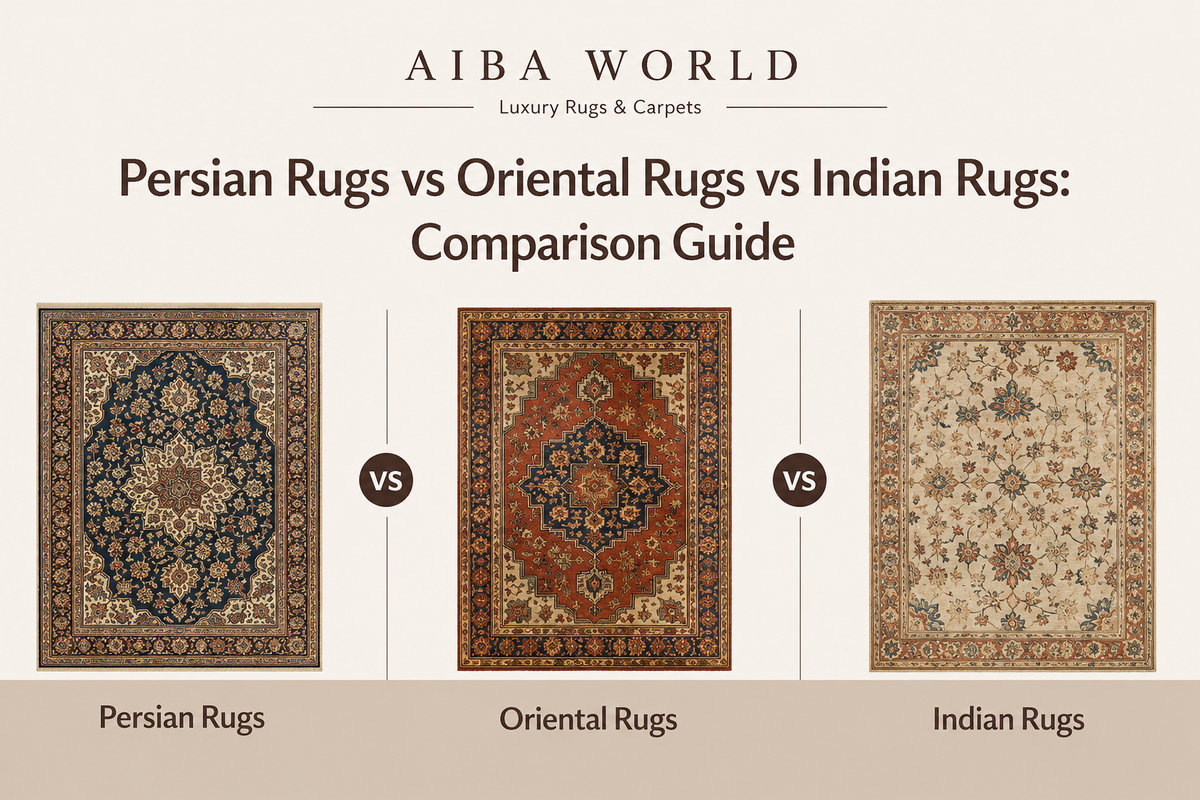
Persian Rugs vs Oriental Rugs vs Indian Rugs: Comparison Guide
It can be a daunting task to find a handmade rug. Are Oriental rugs Persian rugs? Are Indian rugs "real" hand knotted rugs or something else? The terms are used interchangeably in the online world, but they have very different meanings, both in terms of origin and craftsmanship as well as in materials and price.
Persian rugs, Oriental rugs and Indian rugs are all explained in simple terms in this guide, so you'll know what you're getting, its value and what rug is best for your home.
What Is a Persian Rug?
Persian rugs are hand-knotted rugs made in Iran (historically Persia), and are woven in a traditional way by families of artisans who have passed the technique down through generations. Persian rugs are regarded as the standard of handmade rugs and Persian is protected in that its true meaning is that rugs from Iran are Persian, not rugs that look like them.

History: Persian rug weaving has been around for more than 2500 years and the craft has been influenced by royal courts, trade routes and weaving families from various parts of the world, each with their own unique patterns and knotting styles.
Craftsmanship: All true Persian rugs are hand-knotted, and a weaver by hand, row by row, over weeks or months (and sometimes years for larger, more elaborate rugs). That's the difference between a genuine Persian carpet and an imitation.
Materials: The materials used in the making of Persian rugs are usually of high quality sheep's wool, silk or wool-silk mixture, which is soft, has natural sheen and a long lifespan.
Famous weaving cities:
|
City |
Known For |
|
Tabriz |
Fine detailing, medallion designs, high knot density |
|
Isfahan |
Intricate floral patterns, silk foundations |
|
Kashan |
Classic medallion and vine motifs |
|
Qom |
Luxurious silk rugs, often used for display pieces |
Investment value: Because of their craftsmanship, natural materials, and limited production, authentic Persian rugs often hold or increase in value over time, making them a genuine rug investment rather than just a floor covering.
What Is an Oriental Rug?
Oriental rug is a broad, umbrella term - not a single country of origin. It refers to hand-knotted rugs woven anywhere across Asia and the surrounding regions, following traditional Eastern weaving methods. In short: every Persian rug is an Oriental rug, but not every Oriental rug is Persian.

Countries that produce rugs classified as "Oriental" include:
- Iran (Persian rugs)
- India
- Pakistan
- Turkey
- China
- Nepal
- Afghanistan
The Caucasus region (Armenia, Azerbaijan, Georgia)
Common patterns: Oriental rugs have similar design elements, such as medallions, floral vines and geometric borders, with each country contributing its own regional style. Bold geometric designs are common in Turkish rugs, deep reds with tribal designs are popular in Afghan rugs, and Chinese rugs are likely to be more subdued with dragon or nature-inspired designs.
Weaving Traditions: Most authentic Oriental rugs are still hand-knotted using wool, silk, or a blend, though quality and knot density vary widely by region and workshop.
What Is an Indian Rug?
An Indian rug is a handmade rug or hand knotted rug made in India, which has become one of the top exporters of handmade rugs in the world over the last few decades.
History: Indian rug weaving began during the Mughal era when the weavers of Persia were invited to India and taught the local weavers, hence many traditional Indian rug designs still reflect the Persian designs today.

Major Weaving Hubs:
|
Region |
Specialty |
|
Bhadohi |
India's largest carpet-weaving hub, known for hand-knotted wool rugs |
|
Jaipur |
Traditional and contemporary designs, popular in exports |
|
Agra |
Fine Persian-style hand-knotted rugs |
|
Mirzapur |
Wool and woolen-blend handmade rugs |
Production Techniques: Indian rugs are made by hand knotting, hand tufting and flatweave (dhurrie). Hand-knotted Indian rugs are made in a similar labor-intensive manner to Persian rugs, and hand-tufted rugs use a quicker method and are typically less expensive.
Designs: Indian rug makers make traditional Persian designs as well as modern, minimalist rugs that fit the modern interior, providing buyers with greater design options than most Persian workshops.
Export Markets: India exports handmade rugs to a great extent to the UAE, USA and Europe where the pricing is competitive and the craftsmanship is genuinely good.
Design Difference
|
Feature |
Persian Rugs |
Oriental Rugs (General) |
Indian Rugs |
|
Motifs |
Intricate floral, Persian medallions |
Varies by country - geometric to floral |
Persian-inspired florals + modern minimalist |
|
Patterns |
Dense, symmetrical medallions |
Mixed traditions (tribal, geometric, floral) |
Traditional + contemporary collections |
|
Color Palette |
Deep reds, blues, ivory, gold |
Wide range depending on origin |
Earthy tones, pastels, and bold modern colors |
|
Texture |
Dense, fine, silky finish |
Varies (coarse to fine) |
High sheen, reflective luxury finish |
Persian rugs rely on Persian motifs, which are detailed medallions, vines and botanical designs woven with mathematical symmetry. Indian rugs are more diverse, incorporating traditional rugs and contemporary Indian rugs for modern homes with abstract, transitional and minimalist rugs rarely found by the Persian workshops.
Materials Used
The material used in a rug directly affects its wool quality, softness, durability, and price.
- New Zealand Wool: Known for its strength and resilience; commonly used in premium hand-knotted rugs.
- Ghazni Wool: A high-lanolin wool from Afghanistan prized for its natural sheen and softness.
- Silk: Used for fine detailing or entire rug construction; adds a luxurious sheen but is more delicate.
- Bamboo Silk: A more affordable, eco-friendly alternative to natural silk with a similar glossy finish.
- Cotton Foundation: Used as the base/warp structure in most hand-knotted rugs for stability.
-
Natural Vegetable Dyes: Derived from plants, roots, and minerals, these dyes are prized in heritage rugs for their soft, fade-resistant color tones compared to synthetic dyes.
Persian rugs traditionally lean on premium wool and silk with natural vegetable dyes, while Indian rugs offer a wider material range - from pure wool to wool-silk-bamboo blends - to suit different budgets.
Craftsmanship and Knot Density
Hand-knotted construction is the defining feature separating true Persian, Oriental, and high-end Indian rugs from machine-made rugs. Each knot is tied individually by hand onto a cotton or silk foundation, row by row.
|
Knot Density |
Quality Level |
Typical Weaving Time |
|
Below 100 KPSI |
Basic quality |
Weeks |
|
100–200 KPSI |
Good quality |
Several months |
|
200–400 KPSI |
High quality |
6–12 months |
|
400+ KPSI |
Museum/investment grade |
1–3+ years |
Higher knot density means finer detail, sharper patterns, and greater durability - but also significantly more weaving time and cost. This is why premium Tabriz or Isfahan rugs, often woven at 300+ KPSI, command higher prices than a standard Bhadohi wool rug woven at a lower knot count.
|
Factor |
Persian Rugs |
Oriental Rugs (General) |
Indian Rugs |
|
Lifespan |
50–100+ years with care |
Varies widely by origin quality |
20–50+ years (hand-knotted) |
|
Maintenance |
Professional cleaning recommended |
Depends on material |
Moderate, easy-care wool blends available |
|
Foot Traffic Suitability |
Excellent (high knot density) |
Good to excellent |
Good, especially wool-based |
|
Pet-Friendly Options |
Yes, wool resists stains naturally |
Varies |
Yes, especially tightly woven wool rugs |
|
Family Home Suitability |
Great for formal + living spaces |
Great for varied spaces |
Great for every day, high-traffic rooms |
Rug durability largely comes down to knot density and material quality rather than country of origin alone - a high-knot-density Indian wool rug can outlast a low-density rug from anywhere else.
Rug Maintenance Tip: Rotate handmade rugs every 6–12 months, vacuum without a beater bar, and get professional cleaning every 12–18 months to preserve both appearance and resale value.
Which Rug Offers Better Value?
If your priority is rug investment and long-term appreciation, an authentic Persian rug - especially from Tabriz, Isfahan, or Kashan - typically holds the strongest resale value. If you want excellent craftsmanship at a more accessible price point, a hand-knotted Indian rug from Bhadohi or Jaipur offers the best value-to-quality ratio.
What Rugs is Best for UAE Homes?
Climate and lifestyle are as important as design for UAE interiors:
Heat and AC Considerations: Wool rugs will regulate temperatures better than synthetic materials, and will not be as dry as silk rugs over time in air-conditioned interiors.
Dust Considerations: Densely woven rugs (Persian or high-KPSI Indian rugs) hold less dust and are easier to clean than flatweave and loosely woven rugs.
Luxury Villas: In formal living spaces and majlis areas, luxury villas are ideal for Persian or fine Indian rugs made of silk blend.
Apartments: Mid-density wool Indian rugs are durable and convenient to clean for everyday areas.
Hospitality Spaces (hotels, lounges): High-KPSI wool rugs are desired for the durability of the high traffic areas of the hospitality spaces such as hotels and lounges, while maintaining a luxury interior appearance.

What is the best Rug for USA Homes?
Interiors are different across the United States, and the best rug for any interior is determined by the style of the interior:
Hardwood Floor Compatibility: Woolen Persian or Indian rugs with natural rug pads will help protect hardwood floors and provide warmth and texture.
Cold Climates: Thicker wool pile rugs (typical of Persian and Indian wool rugs) offer insulation and feel good underfoot.
Farmhouse Interiors: Geometric-pattern rugs fit well with farmhouse and rustic decor, as do Indian dhurries and flatweave rugs for farmhouse interiors.
Modern Homes: Contemporary Indian collections with simple patterns are a better match for clean, modern interiors of modern homes than are dense traditional Persian medallions.
Traditional Décor: Classic Persian rugs are the preferred choice for traditional and formal American rooms, particularly living and dining rooms.

How to Choose the Right Handmade Rug
Before purchasing any hand knotted rug, follow this simple checklist:
Budget: You should know what you are willing to pay first; Persian rugs are at the higher end of the price spectrum and Indian rugs are of good quality in a variety of price ranges.
Material: Opt for wool for durability and softness, silk for luxury and shine, or a mix of the two for a balance.
Knot Density: The more knots per square inch, the more detailed the image and the longer the image will last – check the number of knots before buying.
Size: Determine the dimensions of your room and furnishings to ensure that the rug fits the room and does not appear too large or small.
Room Type: Consider denser and durable weaves in high-traffic rooms such as living rooms and hallways and finer/delicate weaves in low-traffic formal rooms.
Lifestyle: If you have children or pets, you should consider using tightly woven wool rugs over delicate silk rugs.
Maintenance Needs: Check cleaning suggestions before purchase - some rugs must be professionally cleaned while others can be cleaned at home.
FAQ About Persian Rugs vs Oriental Rugs vs Indian Rugs
Is there any difference between all Persian rugs and Oriental rugs?
Yes, All Persian rugs are considered Oriental rugs since Oriental is a general term that applies to hand knotted rugs from Asian areas and Iran. However not every oriental rug is a Persian rug since oriental rugs also cover rugs from India, Turkey, Pakistan, China and all other countries.
Which rug is long lasting durability?
The rugs with the highest knot density and finest wool or silk material have the longest lasting durability – if used properly, it will be 50 to 100+ years. Whether it is a high quality Persian rug or a high quality hand knotted Indian rug, durability is more a function of the rug's craftsmanship and the number of knots than the country in which it was produced.
Is Indian handmade rugs of high quality?
Yes. Indian Hand-knotted rugs, particularly those made in Bhadohi, Jaipur and Agra, are known throughout the world for their craftsmanship and are often made by the same knotting methods and of the same quality of wool as those used by the Persian workshops, at a more accessible price point.
Why are Persian rugs expensive?
Persian rugs cost a lot of money because they are hand woven for months or even years, use of premium wool or silk, vegetable dyes, and the fact that the craftsmanship is becoming very rare as the centuries go by.
Which rug is the easiest to clean?
Most of the Indian wool rugs are made using mid-density wool, which is easier to maintain than delicate silk rugs, as wool naturally repels stains and dusts.
What rug is ideal for luxurious interior?
Persian rugs, particularly those that are made in silk or a blend of silk and other materials are count in luxury rugs and carpets for luxury interior. Especially those from Qom or Isfahan, where they are known for their intricate designs, natural luster, and their role as heritage investment pieces.
How to tell if a rug is handmade?
Look at the back of the rug - a true hand-knotted rug will have some irregularities in the knots and a pattern that is the same as the front of the rug, whereas a machine-made rug will have a uniform, mesh-like backing. You can also ask for the knot density (KPSI) and country of origin documentation.
Is the price of Indian rugs less than Persian rugs?
Generally, yes. Indian rugs are usually less expensive than authentic Persian rugs due to differences in labor costs and the positioning of Indian rugs in the market, although high knot density, fine silk Indian rugs can be offered at a high price.
Which rug is suitable for homes that have pets?
Persian rugs or Indian rugs are ideal for homes with pets because they are densely woven and will not stain as easily as delicate silk rugs, will not shed, and will withstand scratching.
What is the total cost of the handmade rug?
Yes, particularly hand-knotted Persian rugs and high quality Indian rugs which are made from natural materials and have the highest number of skilled artisans making them today, and therefore are likely to appreciate or maintain their value over time.